


Send the URL and the symptom.
Tell me what changed, when it changed, and what your team has already ruled out. I ask for only the access I need for that scope.
I built the delivery infrastructure for a 21-client agency from zero. Now I work behind SEO and marketing agencies when crawl, indexation, schema, speed, or migration problems get deeper than the team can handle in-house.
A 40-page audit that nobody can act on is not a deliverable. I diagnose the failure. Then I fix it or write the requirements, verify the result, and put your agency's name on the deliverable.
The client sees the traffic line. Your account team sees five possible causes. Your developers need something more useful than “check the technical SEO.”
Guessing is expensive because the wrong fix burns time and weakens the next client conversation. I trace the failure, document the evidence, and give the agency an answer it can stand behind.
Your agency needs an answer it can use with the client and the development team. The job ends with a clear status, not a pile of unchecked recommendations.
Tell me what changed, when it changed, and what your team has already ruled out. I ask for only the access I need for that scope.
I reproduce the problem, check the timeline, and test competing explanations. Your team sees what is proven, what is likely, and what is still unknown.
I ship the correction when access allows it, or give your developers exact specifications. Then I verify the change and give your team notes it can use with the client.
Crawl and indexation failures need different evidence from a backlink attack or a slow template. I scope the work around the actual failure instead of forcing every client into the same audit.
I line up crawls, Search Console, analytics, site changes, and the timeline. The goal is to separate the actual failure from tool noise before your agency promises a fix.
Robots directives, canonicals, sitemaps, redirects, internal links, parameter URLs, and rendering issues. I trace the conflict and give your team the order of operations.
Entity-based JSON-LD, duplicate-markup cleanup, and template-level implementation. I check what the page says, what the markup says, and whether those two stories agree.
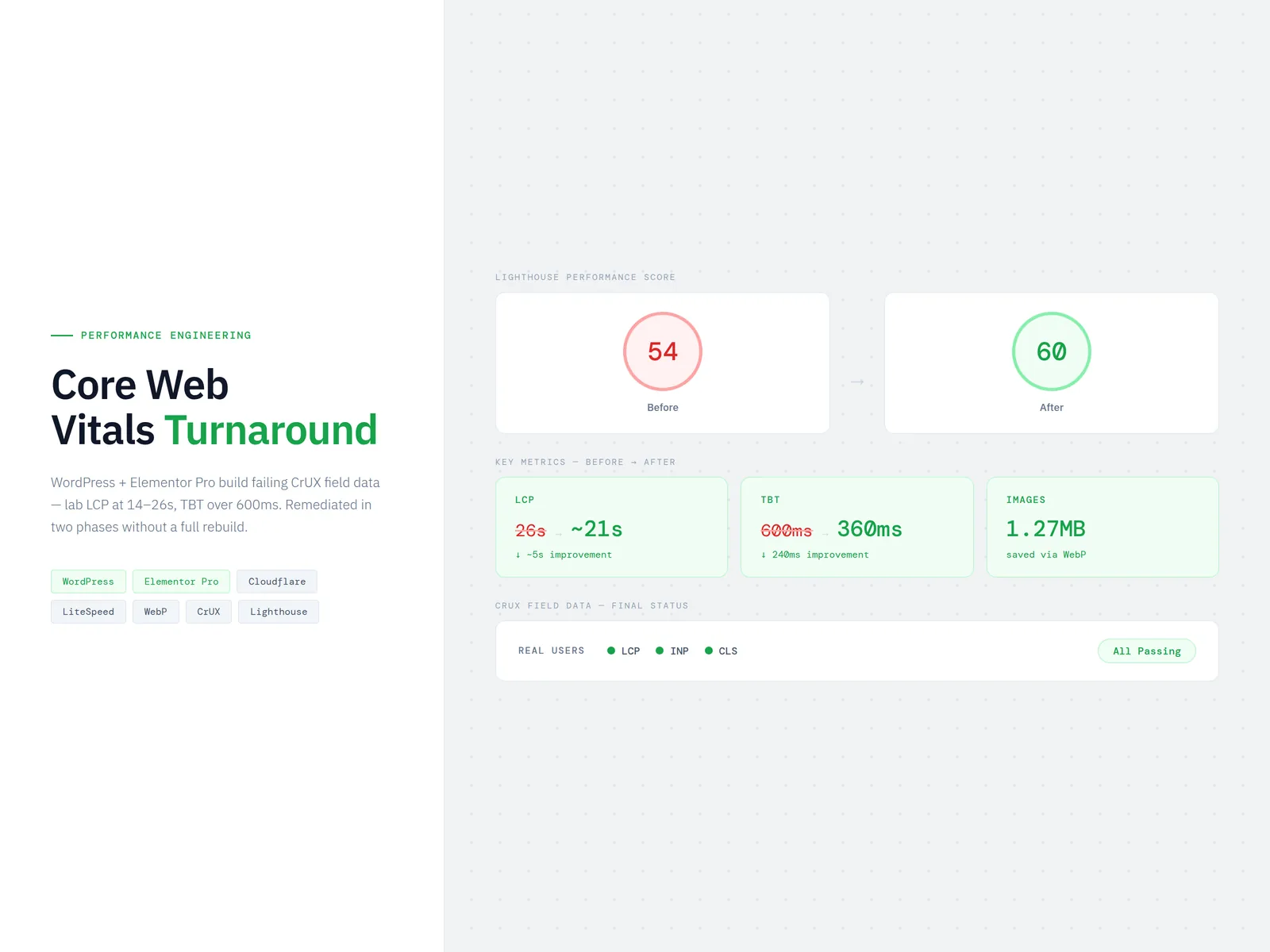
Field data, waterfall evidence, render-blocking assets, caching, third-party scripts, and template weight. I fix the layer doing the damage instead of chasing one lab score.
Change history, URL loss, staging leaks, host failures, backlink attacks, and algorithm timing. When several things broke at once, I document each one instead of forcing a single-cause story.
I would rather be honest about fit than take every project that comes in. If something you send me is not the right move, I will say so and tell you what is.
The $500 Health Check shows how I prioritize a site's technical problems before repair work is sold.
If the client needs a full website built, start with white-label web development. This page is for the search problem.


I work through your agency by default. If direct client contact would help, it happens only when you request it and define the role.
Fixed-scope diagnosis comes first. Follow-through is quoted only when the evidence shows what needs to change.
A defined technical question, a written scope, and a flat quote before work starts.
Defined implementation work uses my public $200/hour benchmark when hourly work makes more sense than a flat quote.
Not sure which technical lane fits? Send the URL, the symptom, and the date it changed.
Send the Symptom →Tell me what changed, when it changed, and what your team has already ruled out. I will tell you if I can own the diagnosis and what the first scope should be.