Home services is the category local search was built for. The customer has a problem in a specific building, they need somebody who can get there, and they are usually deciding inside a day. There is no national competitor to worry about and no funnel to nurture. There is a map with three businesses on it, and you are either in it or you are not.
That makes the work unusually tractable. It also makes it unusually easy to waste money on, because most of what agencies sell contractors — blog volume, social posting, monthly reporting decks — does not touch the things that actually move the map pack. This is the playbook that does, across HVAC, plumbing, electrical, roofing, landscaping and the rest.
What Local SEO for Home Services Actually Is
Local SEO for home services is the work of making a contractor visible in Google Maps and Google Search when someone inside the service area looks for the jobs that contractor wants. It covers the Google Business Profile that feeds the map pack, service pages for each job, honest coverage of the towns served, review signals, and the technical health of the site.
For most contractors the map pack matters more than everything else combined. That is the biggest single difference from ordinary SEO, and it changes where the effort goes.
Three Ways This Differs From Normal SEO
Intent is often urgent. A failed furnace in January and a leaking roof in a storm are not research projects. Speed, a tappable phone number and a page that loads on bad mobile data beat persuasive copy every time.
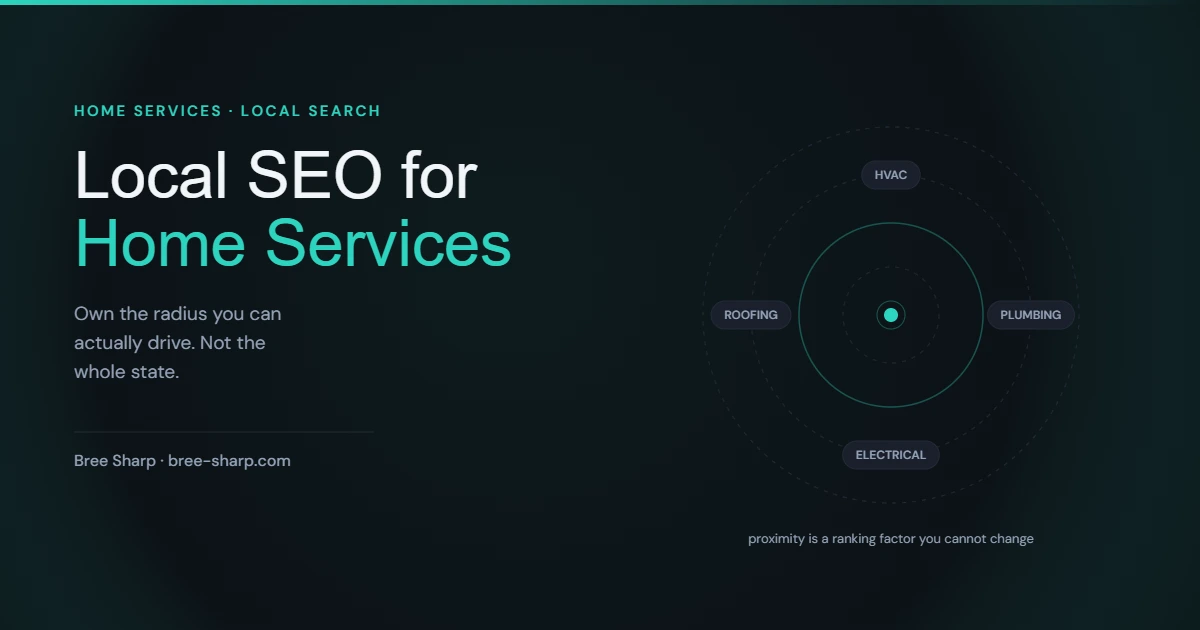
Proximity is a ranking factor you cannot change. Google weighs how close the business is to the searcher. A competitor two towns over will outrank you there and you will outrank them at home. The realistic goal is owning your radius, not ranking everywhere — and any agency promising the latter is selling something.
The profile often outweighs the website. On urgent searches the map block takes most of the clicks, and it is fed by the Google Business Profile. Contractors routinely spend on a website redesign while their profile sits with a wrong category and no photos since 2021.
Getting Into the Map Pack
What moves it, in rough order of leverage:
- Primary category, set precisely. HVAC Contractor, Plumber, Electrician, Roofing Contractor. Not "Contractor." This is the strongest lever you control and a vague setting costs you the exact searches you want.
- Review velocity — steady beats large, covered below.
- Service area set honestly. Four counties means four counties. Listing an entire state dilutes relevance rather than extending reach.
- Secondary categories for jobs you genuinely take.
- Real photos added regularly — job sites, trucks, crews. Stock photography does nothing.
- Accurate hours, including whether you truly answer overnight. Advertising 24-hour service you do not staff earns one-star reviews that cost more than the visibility gained.
A profile audit takes twenty minutes and is the highest-return twenty minutes available to most contractors.
A Page Per Job, Not a Services List
The most common structural problem on contractor sites is a single Services page listing everything the company does. It competes for nothing. Someone searching "furnace replacement cost" and someone searching "emergency AC repair" are different people with different urgency and budget, and one page cannot serve both.
Build one page per job you want more of. Each should cover what the work involves, what drives the price, how long it takes, what the day looks like for the customer, and what to do right now if it is urgent. Publishing price ranges is the thing contractors resist most and customers want most — you do not need to quote a number, but explaining what makes a job $800 versus $8,000 builds trust and wins featured snippets.
The general pattern is in service page SEO for local businesses. The plumbing-specific version, with the actual page list, is in SEO for plumbers.
Location Pages That Are Not Spam
Serve six towns and someone will tell you to build six location pages. Done properly this works. Done the usual way — one template, town name swapped — it produces near-duplicate pages that compete with each other and rank for none of it.
A location page earns its place when it contains something only true of that town: the neighbourhoods and subdivisions you work in, the housing stock and what it means for your trade, response time from your shop, and real jobs completed there. If you cannot write two genuinely specific paragraphs, do not build the page. Cover the town in a service-area section instead.
The failure modes are catalogued in service area pages and how they go wrong.
Review Velocity Beats Review Count
Reviews are the strongest signal a contractor controls that isn't location, and the total matters less than the rhythm. Three or four a month steadily reads as an active business. Forty from two years ago and nothing since reads as one that may have closed.
The ask has to happen at the moment the job is done and the customer is relieved — a card with a short link, or a text from the tech before leaving. Anything sent three days later converts a fraction as well. Do not incentivise, do not filter who gets asked, do not buy them. Respond to every review, briefly, including the bad ones; prospects read the response more carefully than the complaint.
Step by step: how to get more Google reviews.
The Technical Failures That Quietly Cost Calls
The recurring problems I find on contractor sites, roughly by frequency:
- Phone number as an image or plain text rather than a tel: link, removing tap-to-call from a mostly-mobile, often-hurried audience.
- Slow on real mobile connections — usually an oversized hero image and a page builder loading everything at once. It costs most on the urgent searches worth most.
- No LocalBusiness schema, leaving Google to infer address, hours and service area from page text.
- Name, address and phone inconsistent across the site, the Google profile and directories — usually an old suite number or a retired tracking number.
- Pages Google cannot index, from a leftover noindex after a rebuild or a forgotten robots rule.
None of it is glamorous. All of it is cheap relative to what it costs. Fixing tap-to-call and mobile load time often shows up in the phone log before any ranking changes, because the visitors you already had stop leaving.
Auditing Your Own Site
- Search your main terms in an incognito window or on mobile data. Logged-in results are personalised and flatter you.
- Check the map pack specifically. If you are not in the three, look at who is — category, review count, review recency, photos.
- Open your site on a phone on mobile data. Time it. Try to tap the phone number.
- Confirm your pages are indexable with the indexability checker.
- Check your title tags with the title and meta checker.
- Check NAP consistency with the NAP checker.
What This Should Cost
Agencies serving the trades typically quote $1,500 to $5,000 a month. For a single-location contractor, most of that buys content volume and reporting rather than results.
What usually works is more surgical: a diagnostic to find what is broken, the Google profile configured properly once, service pages built well for the jobs you want, the technical layer fixed, then a steady in-house habit of reviews and photos. Mostly project work with a light ongoing commitment.
Red flags: guaranteed rankings, twelve-month contracts before any diagnostic, reports you cannot verify in your own Google accounts, and reluctance to give you admin access to your own Business Profile. The profile is your asset — losing control of it is genuinely expensive.
Want the audit done for you?
The $500 flat-rate site health check covers everything in this playbook — profile, service pages, technical layer and measurement — with a prioritized fix list and a walkthrough call.
FAQ: Home Services Local SEO
What is local SEO for home services?
Local SEO for home services is the work of making a contractor visible in Google Maps and Google Search when someone inside the service area looks for the jobs that contractor wants. It covers the Google Business Profile that feeds the map pack, service pages for each job, honest coverage of the towns served, review signals, and the technical health of the site. For most contractors the map pack matters more than everything else combined.
How is home services SEO different from regular SEO?
Three differences change the strategy. Intent is often urgent, so speed and a tappable phone number matter more than persuasive copy. Proximity is a ranking factor you cannot change, so the realistic goal is dominating a radius rather than ranking everywhere. And the map pack absorbs most of the clicks, which means the Google Business Profile is frequently a bigger lever than the website itself.
Should each trade have its own page?
Yes, if the business genuinely offers them. A company doing HVAC and plumbing needs a page for each, because they are different searches with different buyers. What does not work is one Services page listing everything, which competes for nothing, or a page for every job the business technically can do but rarely takes.
Do location pages still work for contractors?
They work when they contain something only true of that town: the neighbourhoods worked in, the housing stock and what it means for the trade, response time from the shop, and real jobs done there. They do not work as a template with the town name swapped, which Google has been able to detect for a decade and which produces near-duplicate pages that compete with each other.
How much should a contractor spend on local SEO?
Agencies serving the trades typically quote $1,500 to $5,000 a month. For a single-location contractor most of that buys content volume and reporting rather than results. What usually works is more surgical: a diagnostic to find what is broken, the Google profile configured properly once, service pages built well, the technical layer fixed, then a steady in-house habit of reviews and photos. That is mostly project work with a light ongoing commitment.
Where to Start
Claim and complete the Google Business Profile, set the primary category precisely, make the phone number tappable on every page, and start asking every customer for a review at the moment the job finishes. That is a week of work and most of the available gain for a contractor starting from nothing.
What this looks like executed for a real client is in the Kentucky home services case study — landing pages, schema, profile work and technical cleanup on one engagement.